

Where Is My Mind?
Adventures across motherhood, meditation, science & spirituality

My son’s sneakers are falling apart. The corn plant in the corner of the TV room is turning yellow — is it overwatered or unwatered or just cold? And, are you kidding me, the new front walkway cracked in this season’s heavy snow.
I’m cracking too.
Not long ago, I used to negotiate multi-million dollar partnerships. I used to be the person who could seamlessly track the timelines and details of dozens of projects in my head.
Now, I literally cannot remember if I put coffee in the coffee maker. I have pressed start and brewed hot water through an empty filter more times than I’m comfortable admitting.
A similar thing is happening with yogurt.
Every time I’m at the grocery store, I think, “The baby likes 5% Fage. I should stock up.” This feels like a responsible, loving thought. Look at me, providing nourishment for my sweet yogurt-obsessed child.
What I do not think in that moment is: “You have this thought every time you go to the grocery store.” I do not picture the eight tubs of 5% Fage currently living wistfully on the middle shelf of my fridge. I just grab two or three more.
If you’ve been following along, you will be 0% surprised to hear that I blame my kids. And yes, one reason is the year-long lack of sleep. But I’ve been contemplating the state of my mind for months, and while certain wheels have fallen off, it also feels like new ones have bolted on.
I’ve started to suspect that I’m not just “losing it” in the casual sense but undergoing something like a deep biological and spiritual reconfiguration. On one level, it’s an evolutionary adaptation that comes with motherhood. On another, it points toward some of the stranger things we’re (re)learning about consciousness itself.
Maybe I’m not losing my mind, but I’m losing the idea that my mind was “mine” in the first place.
We tend to think of the developmental stages in our lives as: infancy → childhood → adolescence → adulthood → old age.
Women who have kids undergo another little-discussed stage: matrescence. It’s like adolescence in reverse. Instead of gaining independence from your family, your identity expands to encompass new humans.
And this isn’t just “rite of passage” kumbaya cultural stuff, although there’s plenty of that. Our brains actually change during pregnancy and early motherhood.1
One study described the changes as “alter[ing] the neural basis of self”(!) Pregnancy particularly affects the Default Mode Network, or what I like to call our inner “George Constanza” — the parts of our brain that activate when we’re thinking about ourselves, replaying memories and narrating our lives.2
Notably, the Default Mode Network also shows up in psychedelic research. Psilocybin and LSD disrupt the Default Mode Network, chipping away at its usual workings and fostering unusual connections between distant networks within the brain.
During trips that can feel like ego-dissolution or an expansive, intermingled sense of self. In brief shimmering moments, I’ve been absolutely certain I am that mossy rock, that knot in the tree, that I’m not just figuratively “turning into my mother” but actually am her.
Caregivers and infants also co-regulate through coordinated heart-rate variability and stress hormone rhythms.3 This lines up with what I’ve experienced in Reiki: it seems that my clients start to relax simply when I’ve taken the time to cultivate a calm, loving presence.4 Both of us are re-regulating to an open, healing energy.
So in short, the science backs me up: I have bid adieu to the crisp, linear mind that won me academic and professional praise. My new mind is more like interdependent Jello: always scanning for others’ needs and a little wobbly.
The mother–baby dyad is one organism occupying two bodies. A breastfeeding mother knows in her body when her baby needs to eat.
While I’m personally pretty pissed that both my kids said “Dada” months before they said “Mama,” it may be because they didn’t need a word for me. On the continuum between mother and self there is, at first, almost perfect overlap.
The experience of losing my old mind also sent me back to a concept I first bumped into on a meditation cushion: what does it even mean to have a mind?
Let’s pretend that we’re meditating. In that sense, this might not be so different from your usual meditation practice.
You sit on the cushion, set your timer, and start focusing on the experience of the breath. Focus wanders, as minds tend to do. Then you invite (or wrangle) your attention back again and again.
With enough time and reps, or maybe just on a good day, you notice that your mind is enjoying a little calm and a sense of space. You gain some distance from the thoughts, and they get some distance from each other. When they emerge, they pass across the landscape of your awareness like a flock of birds. You watch them come and go.
You start to notice that the thoughts aren’t really “yours.” They often just effortlessly pop up. Even the sense of “yourself” starts to float in and out like Kramer through Jerry’s apartment door.
In Buddhism, this is sometimes called no-mind or no-self. Not in the sense that nothing exists, but in the sense that there is no fixed, separate, unchanging self running the show. The mind is less a thing and more an unfolding process. A river’s flow.
If mind isn’t a thing, then the phrase “my mind” starts to lose some solidity. It starts feeling less “mine.”
And this isn’t just something we notice in the interior landscape of meditation. It shows up in the physical world too.
Think about a time when you walked into a room where there’s just been an argument. Even if the people aren’t there anymore, you can feel it hanging in the air. Something is heavy, sticky, stale. You might even unconsciously frown and shiver to try to shake it off.
We typically write this off as “bad vibes,” with a slightly embarrassed eye-roll. But what if mind is not a private, sealed-off thing, and is instead something that happens in the relational field between us?
We can see this in our families and workplaces where one person’s neurotic anxiety infects everyone. Or in spiritual communities where one grounded teacher can tame a room of monkey minds.
Our minds subtly braid together in ways we don’t often name. Yes, there is mirroring, where I unconsciously put my chin in my hand after you do the same. But we also synchronize heart rates and breathing. We follow each other’s gaze. We align word choice and metaphors. I haven’t tried it yet, but apparently we can even dream for each other. Taken together, it starts to seem less and less like we’re all walking around with our own personal pan-pizza minds.
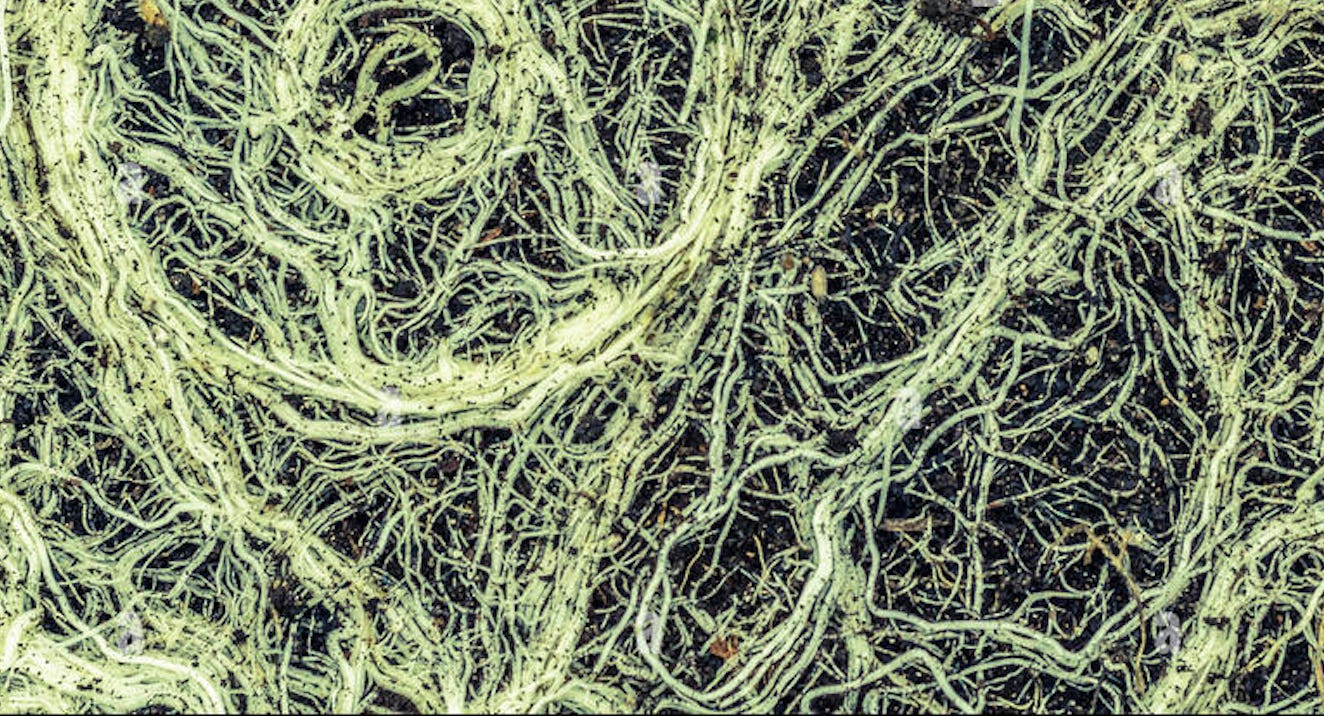
When we look outside the human world, we’re more comfortable with the idea that other creatures are part of complex systems that enjoy a kind of collective knowing. We accept flocks of starlings weaving and dancing across the sky. We’re starting to grok that trees communicate through roots, mycelial networks, and pheromones.5
Eric Markowitz recently wrote a fantastic story about slime mold. If you’re not familiar, slime mold is a kind of yellow goop with no brain or neurons.
I’m paraphrasing, but Japanese scientists set up an experiment where they placed oat flakes on a map in positions corresponding to Tokyo and its surrounding cities. Then they introduced a blob of slime mold. Over time, the slime mold extended itself toward the food sources, building a network of tubes. As it grew, it cut back inefficient routes and reinforced more direct ones. When researchers compared the final pattern of tubes to the existing Tokyo rail system, they looked quite similar. A brainless blob had essentially “solved” the same optimization problem as a team of human engineers.
The slime mold system was sensing the environment, communicating, remembering patterns, and adjusting its behavior over time.
At what point do we feel comfortable saying a system “knows” something? And in what ways is that really different from the ways we say that we know something?
It might be that mind is what shows up whenever a system is sensing, remembering and trying to do something in the world.
Under that definition, the boundaries of “my mind” get very porous very quickly.
We often joke that annoying people live rent-free in our heads. But maybe we are more like birds and trees and slime molds. Maybe we’re all sharing real estate in a collective mind. That’s what some of the ancient Hindu Vedantan schools argue: we’re all fractal or holographic pieces of one being, the divine.
That does sound appealing, but I’m not going to tie this up into a unified theory of everything that explains the nature of consciousness.
Sorry.
I suspect we’re not supposed to understand it all anyway. Trying to pin it down like a butterfly in some specimen box would betray the unruly majesty of experience.
I’m just letting you know that the tight skin-suits we’ve been wearing might not actually fit our mind.
In the age of materialism, “everyone knows” that only what can be seen and measured is real, that consciousness is locked inside individual skulls, that intuition is superstition.
It's like the collective belief that no one could run a four-minute mile. “Everyone knew” that certain physical feats were impossible, until someone ran it and then thousands of people could.
I think our connection, intuition and collective knowing are similar, and that we all have some inborn capacity for it. Being human is much more expansive and naturally magical than we've let ourselves believe.
Maybe these brain changes, this softening of edges and dissolving of the hard “me,” are what older traditions meant by reunifying with the divine mother or embracing the divine feminine. A mother doesn’t just give birth to her child, she gives birth to a way of being in the world where the boundaries between “you” and “I” are more fluid.
Two psychics recently told me that my purpose right now is to give myself over to motherhood.
Ugh.
My immediate temptation was to keep shaking that Magic 8 Ball, ask for another reading, for another way. I want something that sounds better at dinner parties, somewhere that I can really make my mark on the collective.
But on good days, I can see that I’m actually practicing being in the collective. It’s there when I somehow “hear” my daughter minutes before her cries come through the monitor. Or when I can sense what kind of experience the meditation group needs today.
And on other days, it feels like my mind is overloaded with signals, and I just keep buying more yogurt.
Parts of the brain lose some gray matter (local processing power) while the white matter (the wiring between regions) becomes more efficient. On some level, this seems to help mothers detect baby-related signals more quickly, route them through emotional and social circuits, and act on them.
If you’re curious about this, I highly recommend the chapter on the maternal brain in Lucy Jones’ Matrescence.
See this study and this one.
Check out Frans Stiene’s The Way of Reiki for the theory behind this.
Read The Hidden Life of Trees if you haven’t already!
This touched me so deeply. I love the way you weaved the very real, almost comic unraveling of executive function with this much larger reorientation of mind and self. I’m especially moved by the idea that you’re not losing capacity so much as inhabiting a more collective, porous intelligence- one that our culture doesn’t know how to value, let alone name. The image of “interdependent Jello” and of mind as something braided between bodies, rooms, ecosystems… it softened something in me. Thank you for naming this stage with so much honesty and wonder. It made me feel less alone in the wobble.